
Vectra 360 system
At our clinic on Calle Serrano 143 in Madrid (Spain)
Dermatologists specialising in
Full-body mapping for the early detection of skin cancer
Vectra 360 is currently the most accurate technology for the detection of skin cancer, particularly melanoma at its earliest stages. Early detection is directly linked to tumour progression and patient survival in melanoma, a less common form of skin cancer than others, but significantly more aggressive and potentially life-threatening.

Recognised reference clinics in Spain
Home > Skin cancer > Diagnosis > Vectra 360 system
What sets us apart
Advanced and precise diagnosis in a single session
Vectra 360 is a state-of-the-art technology that has transformed dermatological diagnosis and follow-up. This system enables comprehensive, three-dimensional analysis of the skin, identifying subtle changes that may go unnoticed during conventional examinations. Its ability to map the entire body in a single session facilitates early detection of skin abnormalities and optimises treatment planning. By recording and storing high-resolution 3D images, Vectra 360 allows accurate comparisons across follow-up visits, enabling the identification of suspicious changes even at very early stages.

Comprehensive dermatological examination
The Vectra 360 system enables a detailed and global assessment of the skin, including areas that are difficult to examine during routine consultations, such as the scalp, groin and axillae. Its advanced imaging technology overcomes the limitations of manual examination, providing a complete overview of the patient’s skin in a single session, with high-resolution images that support accurate clinical evaluation.
Digital mapping of skin lesions
Vectra 360 generates a detailed digital map of the skin, precisely documenting every mole, spot or skin abnormality. Its advanced technology records the exact location of each lesion, facilitating identification and objective analysis during future assessments.
Automated comparison and early detection of changes
By storing images obtained during successive visits, the system allows precise comparison over time. It can detect changes in moles or skin lesions before they become visible to the naked eye, supporting early diagnosis and more informed therapeutic decision-making.
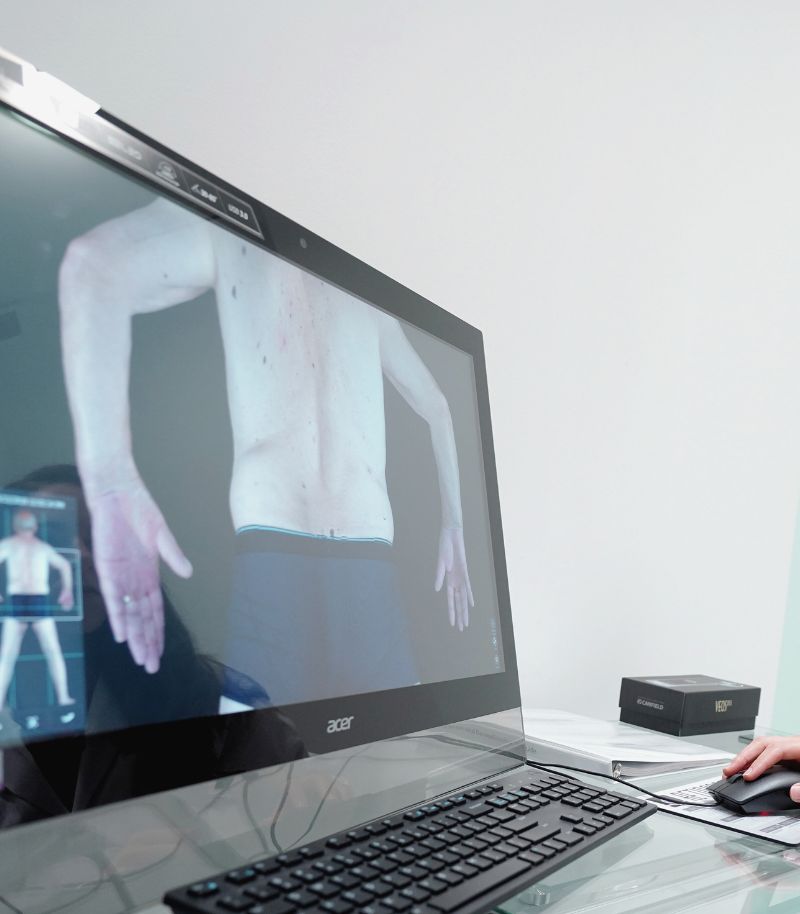
Early, non-invasive diagnosis without discomfort
Vectra 360 enables a comprehensive dermatological assessment within minutes, without invasive procedures or prolonged manual examinations. Its high-precision digital imaging technology supports early detection of skin abnormalities and helps reduce the need for unnecessary biopsies.
Detection of imperceptible changes
This technology identifies millimetre-scale variations in moles and other skin lesions that may go unnoticed during conventional examination. Its ability to detect changes at very early stages allows prompt intervention when malignancy is suspected.
Reduction of unnecessary biopsies and examinations
By providing accurate and objective information about skin lesions, Vectra 360 improves the patient experience, shortens diagnostic times and supports more efficient, data-driven clinical decision-making.
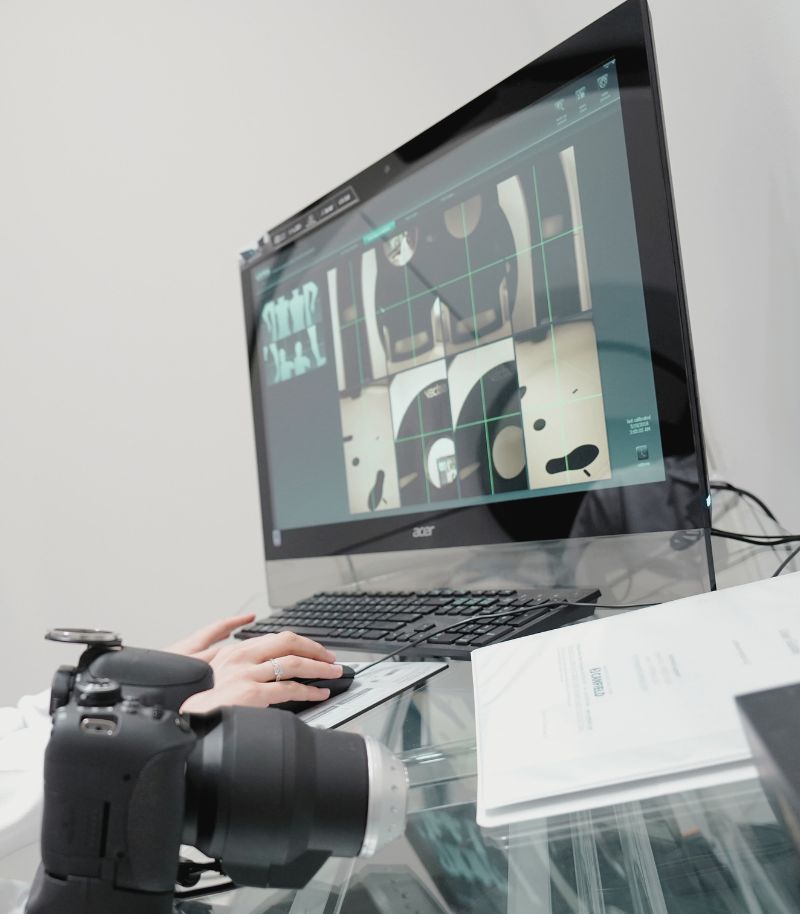
Precise surgical planning
Vectra 360 is not only an advanced diagnostic tool, but also plays an important role in the monitoring of other skin conditions, such as psoriasis, and in surgical planning. Its capacity to analyse the skin in depth and generate high-resolution three-dimensional models enables clinicians to design interventions with exceptional precision, leading to improved functional and aesthetic outcomes.
Optimisation in dermatological and oncological surgery
In dermatological surgery, Vectra 360 allows precise assessment of the extent of suspicious or malignant lesions, helping to plan tissue removal with the least possible invasiveness. In skin oncology, this technology is particularly valuable for defining surgical margins and reducing the need for additional resections, while preserving healthy tissue.
Precision in aesthetic and reconstructive procedures
Beyond medical dermatology, Vectra 360 is also used in aesthetic and reconstructive surgery. Its ability to measure volumes and symmetry with high accuracy supports the planning of procedures such as liposuction, facial lifting or scar reconstruction, contributing to natural and harmonious results.
Early detection of skin cancer
A comprehensive guide to the Vectra 360 system
Vectra 360 enables fast, non-invasive examination of the entire skin surface, including areas that may go unnoticed during self-examination or are difficult to assess in a routine consultation, such as the groin, axillae, and certain areas of the neck or scalp.
In addition, this technology allows the creation of a dermatological map in which the evolution of moles and skin lesions is recorded over time. This enables specialists to identify suspicious changes more reliably and promptly, and to proceed with an accurate diagnosis and early treatment.

What does this technique involve?
Vectra 360 is a large-scale device designed to create a three-dimensional model of the patient’s entire body. It is equipped with a sophisticated system of 98 cameras and cross-polarised lighting capable of capturing images of the entire skin surface, providing an exceptionally detailed view of skin lesions from all angles.
To perform the examination, the patient remains in underwear and stands at the centre of the system, placing their feet on a marked template on the floor and adopting a posture with arms raised to allow full-body image capture.
Once positioned, the patient is asked to close their eyes and, within a single second, all 98 cameras are activated simultaneously. While the patient gets dressed, the system processes, digitises and reconstructs the skin surface, generating a three-dimensional model of the patient’s body. This model precisely identifies every mole, lesion or skin irregularity, which dermatologists can then evaluate and analyse within minutes, using digital dermoscopy or, when appropriate, confocal microscopy.
The importance of early diagnosis in skin cancer
This photographic analysis provides an extraordinarily detailed global view of the patient’s entire skin surface and enables the creation of a dermatological map to monitor the evolution of moles and lesions over time. This makes it possible to clearly and rapidly identify any suspicious change.
Vectra 360 detects potentially malignant changes with a very high level of precision and can identify suspicious alterations when they measure only a few millimetres. Such early diagnosis is essential to establish the most appropriate treatment as soon as possible.
This is particularly relevant given that skin cancer surgery cannot be delayed. Once a skin cancer is diagnosed and surgical treatment is planned, the intervention should take place within a very short time frame. According to specialists in our Skin Cancer Unit, no more than two weeks—three at most—should elapse between diagnosis and surgery, as this timing can have a significant impact on prognosis.
“Grupo Pedro Jaén was the first medical centre in Spain to acquire this system”
Main indications for Vectra 360®
Vectra 360 is primarily used for the diagnosis and surgical planning of skin cancer, but it also has important applications in other areas of dermatology and plastic surgery.
Skin cancer diagnosis
The main beneficiaries of this technology are patients with melanoma. Although melanoma is less common than other types of skin cancer, it is significantly more aggressive, and survival is directly related to the thickness of the malignant lesion at the time of surgical removal. Vectra 360 also supports the diagnosis and management of other skin tumours, including basal cell carcinoma, squamous cell carcinoma and other less common skin cancers.
Surgical planning in skin cancer
Skin cancer often has major functional and aesthetic implications, which must be carefully considered when planning surgery, as many tumours are located in sun-exposed areas of the face, neck or décolletage. The amount of tissue that needs to be removed is therefore a critical factor, regardless of whether the tumour has a favourable prognosis or is potentially life-threatening.
Visualisation with Vectra 360 supports the surgeon’s primary objectives: complete removal of the tumour to achieve cure, while preserving as much healthy tissue as possible to avoid functional impairment or significant aesthetic sequelae.
Accurate assessment of the volume of tissue requiring excision is particularly important in facial areas where skin is limited, such as the nose, periocular region or around the mouth.
In these locations, removing too much tissue can affect eyelid closure, mouth movement (swallowing, chewing or speaking), or result in significant aesthetic deformity when tissue preservation is insufficient.
Localisation and follow-up of skin lesions
Specialists from different units use this system to map psoriatic plaques and assess their progression over time. This allows objective evaluation of treatment effectiveness, identification of changes in lesions and adjustment of therapeutic protocols when necessary.
Planning and plastic surgery
The Aesthetic and Reconstructive Surgery Unit also uses Vectra 360 to plan surgical procedures and accurately determine parameters that previously had to be estimated using more traditional measurement methods.
This technology makes it possible to precisely calculate the volume of fat to be removed during liposuction, achieve greater symmetry in breast implant placement, or more accurately determine the amount of filler required in each treatment area.

More information
Below you will find the authorship and references for the information provided on this page:
Authorship and references
The content of this page has been prepared by the Communication Department and the Medical Team of Grupo Pedro Jaén, in line with our editorial commitment to ensuring the accuracy and up-to-date nature of the information provided.
References on the Vectra 360 system:
1. Primiero CA, McInerney-Leo AM, Betz-Stablein B, et alEvaluation of the efficacy of 3D total-body photography with sequential digital dermoscopy in a high-risk melanoma cohort: protocol for a randomised controlled trialBMJ Open 2019;9:e032969. doi: 10.1136/bmjopen-2019-032969.
2. Rayner JE, Laino AM, Nufer KL, Adams L, Raphael AP, Menzies SW, Soyer HP. Clinical Perspective of 3D Total Body Photography for Early Detection and Screening of Melanoma. Front Med (Lausanne). 2018 May 23;5:152. doi: 10.3389/fmed.2018.00152. PMID: 29911103; PMCID: PMC5992425.
3. Rutjes, C., Torrano, J. & Soyer, H.P. A 3D total-body photography research network: the Australian experiment. Hautarzt 73, 236–240 (2022). doi:10.1007/s00105-021-04938-7
4. Adler, N.R., Kelly, J.W., Guitera, P., Menzies, S.W., Chamberlain, A.J., Fishburn, P., Button-Sloan, A.E., Heal, C., Soyer, H.P. and Thompson, J.F. (2019), Methods of melanoma detection and of skin monitoring for individuals at high risk of melanoma: new Australian clinical practice. Med. J. Aust., 210: 41-47. doi:10.5694/mja2.12033
5. Horsham C, O’Hara M, Sanjida S, Ma S, Jayasinghe D, Green A, Schaider H, Aitken J, Sturm R, Prow T, Soyer H, Janda M. The Experience of 3D Total-Body Photography to Monitor Nevi: Results From an Australian General Population-Based Cohort Study. JMIR Dermatol 2022;5(2):e37034. DOI: 10.2196/37034
Where we see patients?
Centro en Madrid
Grupo Pedro Jaén has several centres located in Madrid and also offers the option of online consultations. The main headquarters is located on Calle Serrano and provides all specialties except trichology, which is offered at the Calle Cinca clinic, just a few minutes’ walk away. For patients in the northern area of Madrid, the group also has a clinic in La Moraleja, where most specialties are available.


Calle Serrano 143
This centre is the main headquarters of Grupo Pedro Jaén. It provides diagnostic and treatment services in skin cancer, clinical and aesthetic dermatology, laser treatments and other related specialties.
Address and contact details
Just a five-minute walk from the Nuevos Ministerios Transport Interchange and only a few stops away from one of Spain’s most vibrant shopping areas—the Golden Mile and Calle Serrano.
Mon - Fri: 09:00 - 21:00
Calle Serrano 143, El Viso neighbourhood, Chamartín district, 28006 Madrid, Spain
Related units and pages
Skin Cancer Prevention
Based on simple self-care measures and more advanced techniques for early diagnosis.
Skin Cancer
Diagnosis using the most advanced systems, treatment and surgery for the different types of skin cancer.
Melanoma
Early diagnosis and treatment of this aggressive skin cancer using the most advanced techniques and technologies.
Basal Cell Carcinoma
Early diagnosis and treatment of the most common type of skin cancer, using the most advanced techniques currently available.
Squamous Cell Carcinoma
The second most common type of skin cancer after basal cell carcinoma, although it is more aggressive.
Clinical dermatology
Highly specialised dermatologists for each skin condition, offering the most advanced treatments available.
Information and news
Press room
In the Grupo Pedro Jaén Press Room you can find information, advice and news related to dermatology, aesthetic medicine, trichology and general health. The group’s journals are also shared through an online platform, along with updates on the activity and media appearances of our clinics and healthcare professionals.

How to shower properly: tips for looking after your skin
Cold or hot water? Is it better to use a sponge? Find out how to shower properly and what dermatologists recommend to protect your skin.

Retinol in summer: should you stop using it?
We debunk this and other myths about using retinol during the warmer months.

Blog
News about Grupo Pedro Jaén. Information and advice on dermatology, aesthetic medicine, trichology, and general health

Media
Information about media appearances by our clinics and medical specialists.

Journal
Archive of all Grupo Pedro Jaén journals, available through an external online platform.