
Lichen planopilaris
Treatment at our clinics in Madrid on Calle Cinca and La Moraleja
Dermatologists specialising in
Treatment of lichen planopilaris
There is currently no treatment that cures lichen planopilaris. However, appropriate management in the early stages of the disease can reduce the development of scarring and, in some cases, allow hair regrowth in areas where irreversible follicular destruction has not yet occurred. Early diagnosis and timely treatment are essential, as once scarring develops, hair loss becomes permanent and cannot be reversed.

Recognised reference clinics in Spain
Home > Hair Disorders > Lichen planopilaris
What sets us apart
Comprehensive and personalised approach
At the Hair Disorders Unit of Grupo Pedro Jaén, we adopt a comprehensive and personalised approach to the management of lichen planopilaris. This includes early diagnosis, targeted treatments to control inflammation and halt disease progression, and advanced cosmetic solutions to optimise appearance and complement medical treatment when needed.
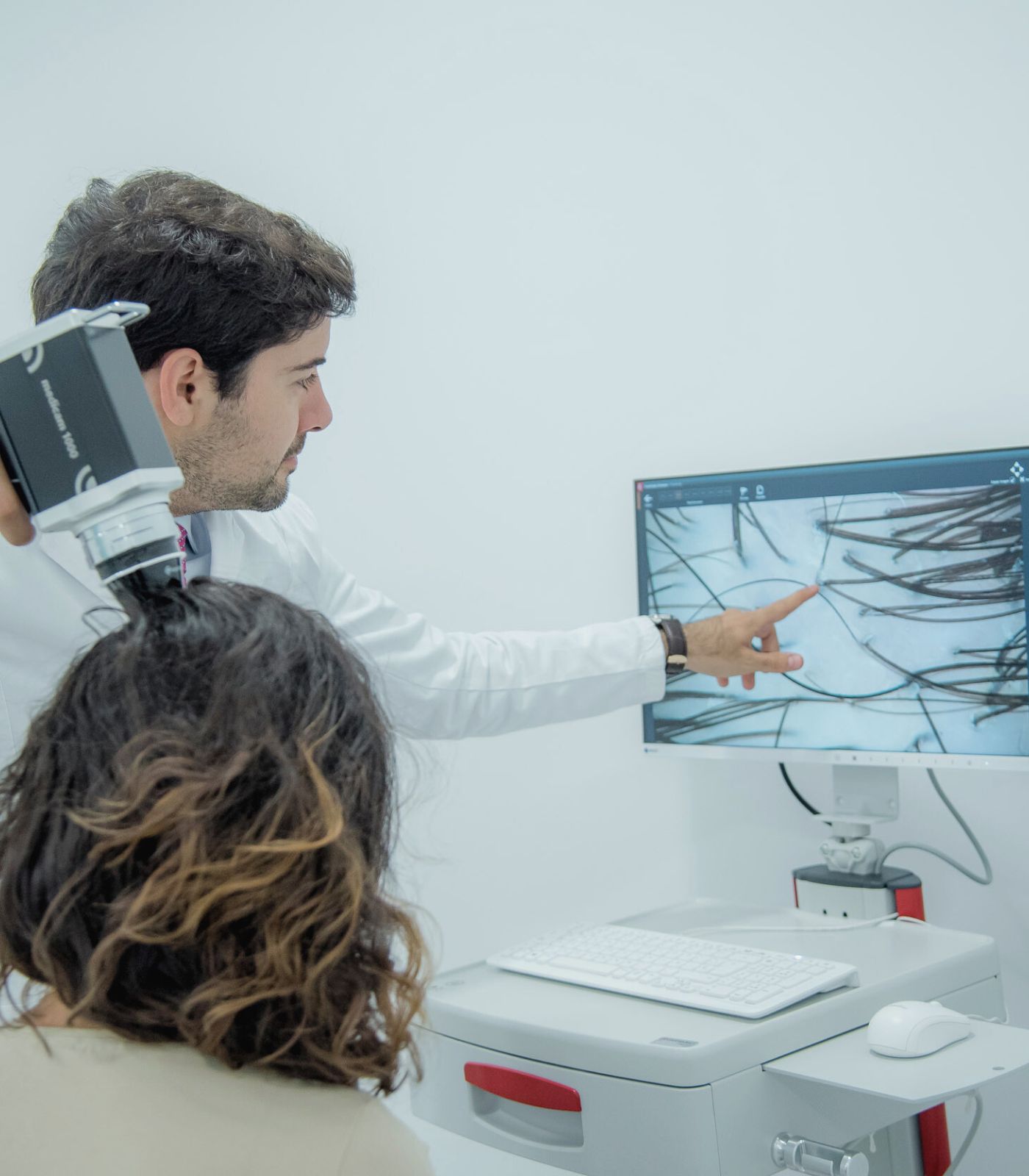
Early and comprehensive diagnosis
Early diagnosis allows for early intervention, which is particularly important given that lichen planopilaris is a scarring alopecia with a high risk of permanent hair loss.
Full clinical assessment
Diagnosis is established during consultation through a detailed medical history and a thorough dermatological examination. Digital trichoscopy is routinely performed to assess hair shaft characteristics and scalp changes that are not visible to the naked eye. In selected cases, a scalp biopsy may be required for histopathological confirmation.
Additional tests
Assessment of thyroid function is commonly indicated, as lichen planopilaris is frequently associated with autoimmune hypothyroidism. This comprehensive diagnostic approach allows for accurate characterisation of the disease and precise therapeutic decision-making.
More information
Disease control and hair transplantation
Early diagnosis allows for early intervention, which is particularly important given that lichen planopilaris is a scarring alopecia with a high risk of permanent hair loss.
Combined treatments to control disease activity
The primary goal of treatment is to control inflammation, prevent follicular destruction and avoid the formation of scar tissue that would permanently impair hair regeneration. Our dermatologists use oral and injectable therapies aimed at reducing inflammatory activity and stabilising the disease, particularly in its early stages. These treatments are often combined with adjuvant therapies to improve prognosis and minimise disease progression.
Hair transplant
Hair transplantation may be considered only in carefully selected patients with long-standing, completely stabilised lichen planopilaris and no clinical or trichoscopic signs of active inflammation. Even in these cases, graft survival rates may be lower than in non-scarring alopecias, so feasibility must be assessed with particular caution. A rigorous evaluation and clear patient counselling are essential to ensure informed decision-making and realistic expectations.
More information

Multidisciplinary care and emotional support
Up to 50% of patients with lichen planopilaris may also present with involvement of the skin, mucous membranes or nails.
Specialist units
Grupo Pedro Jaén has dedicated Clinical Dermatology and Nail Disorders units that provide expert assessment and access to the most advanced treatments currently available for these associated conditions.
Emotional support
The aesthetic impact of lichen planopilaris can be significant and may affect self-esteem, emotional wellbeing and quality of life. For this reason, patients also have access to the Emotional Support Unit, which offers specialised care to help them cope with the psychological impact of the condition.
More information
What it is, types, diagnosis and treatment
Information about lichen planopilaris
Lichen planopilaris is a primary form of scarring alopecia of unknown origin that can affect both men and women, although it is more common in women, typically between the ages of 30 and 60.
This type of alopecia mainly affects the vertex (crown) and interparietal areas of the scalp. However, it may also present in a diffuse manner, giving rise to a pattern known as fibrosing alopecia in a pattern distribution (FAPD).
It is estimated that around half of patients with this form of alopecia also develop lichen planus lesions affecting the skin, mucous membranes or nails.

Causes of lichen planopilaris in women and men
The exact cause of lichen planopilaris is not fully understood. What is known is that it is an autoimmune condition, meaning that the body’s immune system attacks the hair follicle, leading to its destruction. This process may be triggered by various endogenous and exogenous factors, such as viral infections, medications or exposure to sensitising substances. Emotional stress and psychological strain may also act as triggering factors in this autoimmune response.
In all cases, this abnormal immune response ultimately affects follicular stem cells, leading to scarring that prevents hair regeneration and, consequently, the growth of new hair.
Symptoms of lichen planopilaris
Lichen planopilaris typically presents with the progressive appearance of small patches of alopecia in the vertex and interparietal regions of the scalp. These irregularly shaped patches enlarge over the years and tend to merge, forming larger alopecic areas which, if left untreated, become irreversible and result in significant cosmetic disfigurement.
Patients frequently report associated symptoms such as itching, burning or scalp hypersensitivity in the affected areas. These symptoms may appear months before visible hair loss, as alopecic patches usually develop slowly and progressively, although more rapidly progressive cases do occur. Lichen planopilaris may also coexist with lichen planus affecting other parts of the body, such as the oral mucosa.
Diffuse forms of the disease, known as fibrosing alopecia in a pattern distribution, may present with diffuse hair loss accompanied by inflammatory signs on trichoscopy. Correct identification of this presentation is essential in order to initiate anti-inflammatory treatment and halt disease progression.
“Early diagnosis and prompt treatment are essential, as lichen planopilaris is a form of scarring alopecia”
Diagnosis of lichen planopilaris
The diagnosis of lichen planopilaris is made during consultation through a detailed clinical history and physical examination. Digital trichoscopy is also performed to assess the structure of the hair fibre and identify features not visible to the naked eye.
In some cases, histological analysis may be required, which involves performing a scalp biopsy to assess the degree of inflammation or resolve diagnostic uncertainty. This is a simple outpatient procedure that takes less than 15 minutes, is performed under local anaesthesia and requires only a single suture after sampling.
From an analytical perspective, assessment of thyroid function is recommended, as lichen planopilaris is frequently associated with autoimmune hypothyroidism.
Treatment of lichen planopilaris in women and men
At present, there is no curative treatment for lichen planopilaris. However, when appropriate therapy is initiated in the earliest stages of the disease, the development of scarring areas can be reduced and, in some cases, alopecic patches may be reversed where irreversible follicular destruction has not yet occurred.
For this reason, early diagnosis and prompt treatment are crucial, as lichen planopilaris is a scarring form of alopecia. As hair loss progresses, the affected areas develop scar tissue that permanently prevents hair regrowth.
Pharmacological treatments for lichen planopilaris
Depending on individual patient needs, dermatologists specialising in hair disorders may prescribe oral or injectable medication to reduce inflammation associated with lichen planopilaris and prevent the formation of scar tissue. Additional treatments may also be used to address concomitant conditions, such as local infections, which can worsen the disease.
Other therapies for lichen planopilaris
Complementary therapies aimed at improving hair thickness and reducing inflammatory activity include treatments that promote thickening of the hair fibre, biostimulation techniques and low-level laser therapy.
The primary objective of treatment is to stabilise the disease and halt progression, rather than reverse established hair loss. Once hair has been lost in a scarred area, regrowth is not possible, and cosmetic measures or scalp prostheses may be required to restore appearance
However, in patients with early-stage lichen planopilaris, certain treatments may help thicken unaffected hair, resulting in modest improvements in overall hair density. This further underlines the importance of early diagnosis and intervention.
Hair transplantation for lichen planopilaris
One of the most common questions raised by patients is whether hair transplantation is suitable for areas affected by lichen planopilaris.
In general, hair transplantation is not considered an ideal option for this condition. It may be considered only in carefully selected patients with fully stabilised disease and no signs of active inflammation. Even in these cases, transplanted follicles tend to have a lower survival rate, and there is an increased risk of graft loss over time.
For this reason, it is essential that patients are fully informed of these limitations and engage in open discussion with their specialist to determine whether surgery is appropriate and worthwhile in their specific case.
It is essential for patients to be aware of these factors before considering surgery and to maintain good communication with the specialist in order to understand in which cases the procedure may be worthwhile.

More information
Below you will find the authorship and references for the information provided on this page:
Authorship and references
The content of this page has been prepared by the Communication Department and the Medical Team of Grupo Pedro Jaén, in line with our editorial commitment to ensuring the accuracy and up-to-date nature of the information provided.
References on lichen planopilaris:
1. Vano-Galvan S, Trindade de Carvalho L, Saceda-Corralo D, Rodrigues-Barata R, Kerkemeyer KL, Sinclair RD, Hermosa-Gelbard Á, Moreno-Arrones ÓM, Jimenez-Cauhe J, Bhoyrul B. Oral minoxidil improves background hair thickness in lichen planopilaris. J Am Acad Dermatol. 2020;11:S0190-9622(20)30566-1.
2. Fonda-Pascual P, Moreno-Arrones OM, Saceda-Corralo D, Rodrigues-Barata AR, Pindado-Ortega C, Boixeda P, Vaño-Galvan S. Effectiveness of low-level laser therapy in lichen planopilaris. J Am Acad Dermatol. 2018;78(5):1020-1023.
3. Rácz E, Gho C, Moorman PW, Noordhoek Hegt V, Neumann HA. Treatment of frontal fibrosing alopecia and lichen planopilaris: a systematic review. J Eur Acad Dermatol Venereol. 2013;27(12):1461-70.
4. Saceda-Corralo D, Fernández-Crehuet P, Fonda-Pascual P, Pindado-Ortega C, Moreno-Arrones OM, Vañó-Galván S. Clinical Description of Frontal Fibrosing Alopecia with ConcomitantLichenPlanopilaris. Skin Appendage Disord. 2018;4(2):105-107.
5. Svigos K, Yin L, Shaw K, Gutierrez D, Peterson E, Lo Sicco K, Shapiro J. Use of platelet-rich plasma in lichen planopilaris and its variants: A retrospective case series demonstrating treatment tolerability without koebnerization. J Am Acad Dermatol. 2020 Nov;83(5):1506-1509. PMID: 32553684.
Where we see patients?
Clinics in Madrid
Grupo Pedro Jaén is a medical group with more than thirty years of experience, specialising in medical, surgical and aesthetic solutions related to skin health and care. Under the leadership of Dr Pedro Jaén, the group has a multidisciplinary team of highly qualified specialists, ensuring expert care across all areas of treatment. In addition, Grupo Pedro Jaén is recognised for its strong commitment to medical education, its leadership in clinical research and its network of clinics in Madrid, from which it provides healthcare of the highest quality and excellence to its patients.


Calle Cinca 30
Located in the El Viso district, this centre houses the consultations of the Hair Disorders and Hair Transplant Unit of Grupo Pedro Jaén in central Madrid.
Mon - Fri: 09:00 - 20:30
Calle Cinca 30, El Viso neighbourhood, Chamartín District, 28002 Madrid

La Moraleja
Located in Plaza de La Moraleja, this exclusive centre allows Grupo Pedro Jaén to bring its medical and aesthetic services closer to patients across the entire northern area of Madrid.
Mon - Thu: 09:30 - 20:00 / Fri: 10:00 - 18:00
Calle de la Estafeta 8, ground floor, La Moraleja, 28109 Alcobendas, Madrid, Spain
Related units and pages
Hair Disorders Unit
A specialised medical team and the most effective treatments for all types of hair disorders.
Hair transplant
En varones y mujeres, cuando se ha perdido densidad capilar y se busca recuperarla de forma notoria
Hair loss diagnosis
Diagnosis of alopecia using advanced technology and an expert medical team to determine the most appropriate therapeutic approach.
Female alopecia
Individualised diagnosis and specific treatments for the different types of alopecia in women.
Frontal fibrosing alopecia
Personalised treatment based on the extent of hair loss and the degree of scalp inflammation.
Alopecia areata
Treatments aimed both at promoting hair regrowth and preventing common relapses.
Information and news
Press room
In the Grupo Pedro Jaén Press Room you can find information, advice and news related to dermatology, aesthetic medicine, trichology and general health. The group’s journals are also shared through an online platform, along with updates on the activity and media appearances of our clinics and healthcare professionals.

How to shower properly: tips for looking after your skin
Cold or hot water? Is it better to use a sponge? Find out how to shower properly and what dermatologists recommend to protect your skin.
Retinol in summer: should you stop using it?
We debunk this and other myths about using retinol during the warmer months.

Blog
News about Grupo Pedro Jaén. Information and advice on dermatology, aesthetic medicine, trichology, and general health

Media
Information about media appearances by our clinics and medical specialists.

Journal
Archive of all Grupo Pedro Jaén journals, available through an external online platform.